Showing posts with label Lyn Miller-Lachmann. Show all posts

Monday, December 2, 2024

ASHA and NCTE 2024

I'm presenting at the ASHA (American-Speech-Language-Hearing Association) Annual 2024 Conference in Seattle on Thursday, December 5, at 5:30pm.  If you are at the conference, I will be in Summit  433-434 on the fourth floor. My topic is "The Write Stuff: Creating Narrative-Based Interventions for Articulation, Decoding, Executive Functions, and More." Even if you can't come to the conference, check out my handout packet using the QR code below. The packet will give you a chance to preview the beginning of my new book, The Raven Remix: A Mashup of Poe TitlesAll the activities are based on The Raven Remix Activity Book, coming in early 2025.


Last week I was in Boston for the NCTE (National Council of Teachers of English) conference, where I spoke on a panel with Jolene Gutierrez, Beth Anderson, and Debbie Myers on the topic of using Illustrated Narrative Non-Fiction as a bridge to traditional non-fiction. 


While I was at NCTE, I got the chance to go to dinner at a fun Italian restaurant in the Seaport with Leslie Roessing, who wrote a chapter for my book, Story Frames for Teaching Literacy: Enhancing Student Learning Through the Power of Storytelling. Use the code AF on the Brookes website for a 10% discount. Although I have known her for years, this was the first time I ever met her in personSee my interview with her about Teaching Memoir Writing to Kids. Find her books (The Write to Read and more...) on Amazon. She also has a great website, Literacy with Lesley, which lists her books, informative blog posts on a variety of topics, book reviews, and more reading and writing strategies than I could count. Lyn Miller-Lachman was also part of our dinner party. I interviewed her three years ago, talking about her book, Rogue, and her personal challenges with Asperger's Syndrome. Read that blog post HERE, check out all the new books on her Amazon page, and visit her Website


I also got to meet some fun new people, including Jo Watson Hackl (see her Website), author of Smack Dab in the Middle of Maybe, and blogger Melissa Thom. Check out Melissa's author interviews at the Joyful Learning Podcast

Next year NCTE will be in Denver!! No telling who I might run into then.

Wednesday, April 13, 2022

Autism Awareness Month

I'm very excited to share the news that just out in April, 2022, is a new book about Temple Grandin. She Persisted: Temple Grandin is a chapter book from the She Persisted series written by Lyn Miller Lachmann.   

I interviewed the author, Lyn, in April of 2021 about her challenges with Asperger's Syndrome and her fiction title, Rogue. It's about a young girl on the spectrum who views herself like the X-Men character,  Rogue. It contains biographical connections to Lyn Miller-Lachmann's personal experience with Asperger's. Find that interview HERE.  

There have been several books for children written about (and by) Temple Grandin for a wide range of age groups. Last April, I wrote a post exploring several titles. Find that post HERE.


Another book to check out is I Am Odd, I Am New written by Benjamin Giroux, a child with Asperger's Syndrome when he was ten-years-old.  There is a great post describing the book at Unpacking the Power of Picture Books.  The original poem may be found at the Good News Network.

Check out the recent post from Brooke's Publishing on 13 Ways to Support the Behavior and Learning of Students on the Autism Spectrum.

For additional resources, check out the following websites:

Autism Speaks

Autism Society

Organization for Autism Research

Understood

Subscribe to my monthly newsletter HERE and receive a FREE fill-in-the-blank story template PDF called Travel Trouble. Each month you will get updates, activities, and tips about writing and working with students along with book news. 

Monday, April 26, 2021

BOOKS FOR KIDS WRITTEN BY PEOPLE WITH AUTISM


Freaks, Geeks, and Asperger Syndrome: A User Guide to Adolescence was written by Luke Jackson when he was 13 years old. He has Asperger Syndrome and also has a brother on the autism spectrum and another with AD/HD. His book provides tips on bullying, friendship, dating, and relationships. He also talks about how and when to talk to others about being on the autism spectrum. The insights this book provides are useful to parents and teachers as well as to people with AS. The book is 216 pages long and for ages 11-18.

In Rogue by Lyn Miller-Lachmann. Kiara, an eighth-grade girl with Asperger’s is shunned at school and expelled after a violent outburst. She finds friendship with a neighbor boy until dark family secrets (his parents run a meth lab) threaten to destroy more than the budding kinship. Kiara finds inspiration with the X-Men character, Rogue (a mutant who unintentionally hurts anyone she touches until she learns to control her superpower). Kiara eventually discovers that she might just have special gifts of her own- The author, Lyn Miller-Lachmann, has Asperger’s Syndrome which lends authenticity and perspective to the story. Read my interview with Lyn HERE. 241 pages for grades 5-10. 

Out just this month (April 6) is a new book by Temple Grandin- The Outdoor Scientist: The Wonder of Observing the Natural World. This book is 208 pages long for grades 3-7 and contains 40 outdoor projects as well as information about Temple and other scientists who explore the natural world. 

Calling All Minds: How to Think and Create Like an Inventor, also by Temple Grandin, looks at the science and methodology behind various inventions and shows kids how to think like an inventor. Temple talks about the inventions she created as a child. It is 240 pages long and is for kids in grades 3-7. Read more about Temple Grandin and her other books in last week's post.

See books for kids written about the life of Temple Grandin in my April 11 Blog Post.

This last book is not specifically written for kids. It has received both criticism and accolades. I will share both sides of the conversation. The Reason I Jump: The Inner Voice of a Thirteen-Year-Old Boy With Autism was written by Naoki Higashida, a thirteen-year-old boy on the spectrum. He is described as being nonverbal, though to clarify, he is able to read out loud as is described by the translator, David Mitchell in the notes at the end of the book. It is unscripted conversations with which Naoki struggles. Even answering simple questions verbally is a challenge. He reportedly wrote his book (a Q&A interspersed with short, fictional stories) by pointing to letters on an alphabet grid that someone else transcribed into words and sentences. The book has received praise for providing unique insights into autism. It has also received criticism by those who question the validity of the methods used to elicit the answers to the Q&A saying it feels a bit too much like Facilitated Communication (FC) which has been debunked as pseudoscience. In FC an assistant guides and supports the hand of a non-verbal person as they point to letters. That was not the case with Naoki, but he did point to letters on a board in response to questions as opposed to typing them on a computer keyboard or communication device.

ASHA (American Speech-Language-Hearing Association) discourages the use FC and Spelling to Communicate. Read the ASHA  perspective to learn why. They do support independent typing as well as other forms of augmentative and alternative communication that are more independent in nature.

David Mitchell, the best-selling author of Cloud Atlas, translated Why I Jump into English with his wife, K.A. Yoshida. Mitchell appears in a video interview talking about his experience with the translation. He first became acquainted with Naoki's story when trying to better understand his own son with autism. He then set out to translate the book from Japanese into English so that he could share the story and its insights with his son's teachers. Watch his interview on YouTube and read his Q&A HERE

At the end of the English translation of the book, Mitchell talks about conversations he has had with Naoki using his communication board. He also says that Naoki is a motivational speaker who reads aloud from a prepared script. He does not answer questions from the audience verbally, though. He types those responses. I looked on YouTube but could not find any examples of these motivational talks. If anyone is aware of any, I would like to know.

A 2020 documentary film of the same title inspired by the book features 5 other young people with autism. Watch the TRAILER to learn more. 

Read this blog post by the National Council on Severe Autism which raises concerns about the movie. 


Saturday, April 17, 2021

INTERVIEW WITH LYN MILLER-LACHMANN (Talking About Asperger Syndrome)


Lyn Miller-Lachmann is the author of the middle grade and young adult novels Gringolandia, Surviving Santiago, and Rogue, with two new novels, Moonwalking and Torch, forthcoming in 2022. She also edited Once Upon a Cuento which is a collection of short stories for young readers written by emerging Latino authors. She lives in New York City. She is joining me today to talk about her young adult novel, Rogue

Carolee: How did your experiences with having Asperger’s impact writing Rogue, a story about a girl with Asperger Syndrome? 

Lyn: I was diagnosed with Asperger’s 15 years ago, a diagnosis that has since 2013 been folded into the autism spectrum. At that time, I’d published one novel, with another recently accepted by the same publisher. Neither of them had autobiographical elements; in fact, I’d avoided writing a protagonist like myself because I didn’t want to remember the bullying and exclusion I experienced as a child. My diagnosis changed that. Finally, I had an answer for why I was different, why I had trouble understanding and following rules, why so many of my peers took advantage of me or bullied me for sport. I wanted to write a novel to show kids like me that they are not alone. Rogue is based on a choice I had to make when I wasn’t much older than Kiara—to keep doing something I knew was dangerous and wrong in order to be part of a group, or to stop letting these kids use me even if it meant being on my own and bullied again. 


Carolee: It was very brave of you to share so much of your personal experience in the story. One of the benefits of writing about our personal experiences through fiction is that the reader connects with the truth and honesty behind what we write, but at the same time never knows how much of the story is truth and how much is fiction. Why did you decide to write about your experiences as fiction rather than as a traditional autobiography? 

Lyn: I’ve fictionalized in service to the story, in order to create a book that readers will want to read. In Rogue, I began with a “What if?” Like Kiara, I tried to sit at the popular girls’ table in seventh grade thinking that’s how I could become popular, and one of the girls pushed my lunch tray to the floor. I did nothing in response, just stood there crying, but for decades I asked myself what would have happened if I’d picked up the tray and smacked her in the face with it. I would have salvaged my dignity, but I would have also gotten into a lot of trouble. So at the beginning of Rogue, Kiara does pick up the tray and hit the bully with it. And it creates a big problem for her, because she’s suspended for the rest of the school year. She wants to have friends and to belong to a group, but now she’s even more isolated, and the New Kid who moves in around the corner really is her last chance to make a friend for a long time. 

Carolee: Amy Miller, director of the May Center in Santa Fe, NM, wrote a chapter for my new book, Story Frames for Teaching Literacy. Her chapter is “Fostering a Growth Mindset: Strengths-Based Super Hero Stories.” The May School is for students with learning differences. Amy heads a project called The Dyslexia Justice League and one of the ways she helps students to discover their “superpower” is to teach them to write superhero stories. In Rogue, the main character, Kiara, finds that she has special talents and unique gifts. She does this partly by identifying with the mutant X-Men character named Rogue. Do you have any suggestions for young writers about writing their own superhero stories or about writing stories in general? 

Lyn: No matter what you write, the most important thing to do is to read. It will give you ideas and help you figure out what kinds of stories and characters you like and don’t like. A lot of times, the characters that feel closest to you—whether or not they’re superheroes—are the ones most like you. For instance, the X-Men character Rogue is most like Kiara because she can’t touch or be touched and she learns about emotions and what to say or do from watching others. Sometimes, the characters you respond to are the ones who do the things you wish you could do, like be good at sports if you are not. Writing your own story is your chance to be someone different, or be yourself but rewrite the past or possess a special power you don’t have in real life and see what you can accomplish with it. 

Carolee: Speaking of heroes, early in Rogue, a friend of Kiara’s family gives her a book by Temple Grandin entitled Animals in Translation: Using the Mysteries of Autism to Decode Animal Behavior. She tells Kiara that Temple has a “special talent” for understanding animals. Temple Grandin, an animal scientist on the autism spectrum, becomes a role model and a hero of sorts to Kiara. Tell us a little bit about the people who have been your real-life heroes. 

Lyn: Temple Grandin is one of my heroes as well, ever since I read Dr. Oliver Sacks’s profile of her in The New Yorker in the 1990s and recognized so much of myself in her. Although I wasn’t diagnosed until almost ten years later, it meant a lot to me to see someone who had become as successful as she had and whose different ways of seeing the world has had such an impact on the way we treat the animals we raise for food. In general, my heroes are people who have defied convention and authority to make a positive impact on the world. Many of them are human rights activists, people who have resisted brutal dictatorships to bring democracy to their countries (like my protagonist’s father in another one of my novels, Gringolandia) or who have fought for the rights of people with disabilities and others who have been excluded or faced discrimination. 

Carolee: Is there anything else you would like to say to young people struggling to find their place in the world? 

Lyn: Do what you love, pursue your dreams, and find the people who understand you. And when you do find those people, try to be a good friend as well. Being a good friend is one of the things I still strive (and sometimes struggle) to do. It’s at the heart of Kiara’s journey in Rogue and of JJ’s journey in my forthcoming middle-grade verse novel Moonwalking, which I’ve written with my friend Zetta Elliott. 

Carolee: Thank you for joining us and for sharing your experiences as a person with Asperger’s. I have thoroughly enjoyed reading Rogue and look forward to Moonwalking and Torch. You are a hero who is making a positive impact on the world with your stories! 

Lyn: Thank you for inviting me!

Read about books for kids written by Temple Grandin in last week's post as well as books written about her life - Books for Kids by (and about) Temple Grandin - Celebrating World Autism Month.

Sunday, April 11, 2021

BOOKS FOR KIDS by (and about) TEMPLE GRANDIN - CELEBRATING WORLD AUTISM MONTH


Temple Grandin is a professor of animal sciences at Colorado State University and specializes in the humane treatment of livestock animals. She has written numerous scientific papers about the humane treatment of animals as well as books about caring for and understanding animals such as Animals Make Us Human: Creating the Best Life for Animals and Animals in Translation: Using the Mysteries of Autism to Decode Animal Behavior.

Temple is also autistic and often speaks at educational conferences about her experiences growing up on the spectrum. She has written books on that subject for adult audiences such as Thinking in Pictures: My Life with Autism and Emergence: Labeled Autistic

She has also written books for kids, mostly about the sciences, but weaving in her personal experiences such as Calling All Minds: How to Think and Create Like an Inventor pictured above. This book looks at the science and methodology behind various inventions and shows kids how to think like an inventor. Temple talks about the inventions she created as a child. It is 240 pages long and is for kids in grades 3-7. 

Out just this past week is a new book by Temple - The Outdoor Scientist: The Wonder of Observing the Natural World. pictured above. This book is 208 pages long for grades 3-7 and contains 40 outdoor projects as well as information about Temple and other scientists who explore the natural world.


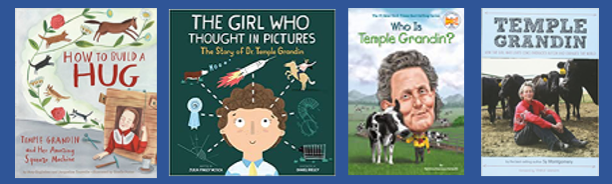
Many other people have written books for children about Temple Grandin and her experiences with autism. How to Build a Hug: Temple Grandin and Her Amazing Squeeze Machine written by Amy Guglielmo and Jacqueline Tourville and illustrated by Giselle Potter, is a 48-page picture book for grades PreK-3.

The Girl Who Thought In Picture: The Story of Dr. Temple Grandin (Amazing Scientists)  written by Julia Finley Mosca and illustrated by Daniel Rieley is for grades K-5 is told in rhyme with cartoon illustrations and is 40 pages in length.

For middle-grade readers, there is Who Is Temple Grandin? written by Patricia Brennan DeMuth and illustrated by Robert Squler. This book is from the Who Was series and is 112 pages in length for grades 3-7. The black and white illustrations provide a nice addition to the story. It is written like a narrative of Temple's life from her early struggles with autism to her great achievements as an adult.

Temple Grandin: How the Girl Who Loved Cows Embraced Autism and Changed the World by Sy Montgomery has a foreword written by Temple Grandin.  It is 160 pages long and for grades 5-7 and is written as traditional non-fiction with numerous facts and photographs.

Watch for next week's post where I will interview another author on the autism spectrum - Lyn Miller-Lachmann who has been diagnosed with Asperger Syndrome. Her book, Rogue, is for grades 7-10 and features a main character with Asperger's who identifies with the X-Men character, Rogue, because she has so much trouble fitting in with her peers. She eventually discovers her own unique gifts and this helps her begin to find her place in the world.