Beth Anderson is joining me today for a Q&A on her latest book, Cloaked in Courage: Uncovering Deborah Sampson, Patriot Soldier. Beth is a former educator and author whose well-researched books make history come alive for young people. I also appreciate how she discovers little-known characters and shares their fascinating adventures with her readers. I frequently use narrative non-fiction picture books with struggling readers. Her books are some of my favorites and theirs. I featured one of her titles, An Inconvenient Alphabet: Ben Franklin and Noah Webster's Spelling Revolution, in my resource for educators - Story Frames for Teaching Literacy (Brookes Publishing, 2021). An Inconvenient Alphabet takes place in the years after the Revolutionary War and would be a good title to explore alongside Cloaked in Courage which will be available on November 15, 2022. Scroll to the bottom of this post to find out how to pre-order Beth's new book and get some fun book swag in the process.
LINKS TO THE COMMON CORE
I was excited for the opportunity to preview Cloaked in Courage and to ask Beth some questions about the story. Because of its historical context, Beth's book is appropriate for students of all ages. Teachers of older students may be interested to know how the story may be linked to the Common Core State Standards:
Grade 3 - CCSS.ELA-LITERACY.RL.3.9 requires students compare stories written by the same author. Ask students to Compare and Contrast Cloaked in Courage with another book by Beth Anderson. I suggest Revolutionary Prudence Wright: Leading the Minute Women in the Fight for Independence. Both stories are about real women who were instrumental in helping America in the fight for freedom.
Grade 4 - CCSS.ELA-LITERACY.RL.4.6 requires students to compare and contrast the point of view from which stories are narrated, including the difference between first- and third-person narrations
. Cloaked in Courage is written in the third person as are most biographical stories. Compare it to
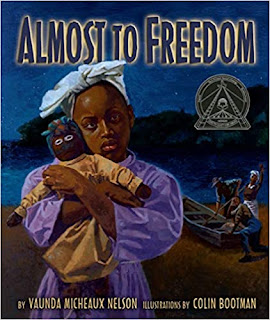
Almost to Freedom told from the perspective of a doll that belongs to a family escaping to freedom through the Underground Railroad. It is written by Vaunda Micheaux Nelson and illustrated by Colin Bootman who won a Caldecott Honor for his masterful artwork.
Grade 5 - CCSS.ELA-LITERACY.RL.5.9 requires students to be able to compare stories in the same genre specifically in regard to looking at how different authors handle similar subjects. Comparing Cloaked in Courage to Gingerbread for Liberty! How a German Baker Helped Win the American Revolution by Mara Rockliff would be a fun fit for addressing this standard. You could also compare An Inconvenient Alphabet to another book by Mara Rockliff, Mesmerized: How Ben Franklin Solved a Mystery that Baffled All of France. Both of those books share little-known stories about a well-known historical figure, Benjamin Franklin. Both of Mara Rockliff's books are featured in Story Frames. Grade 6 -
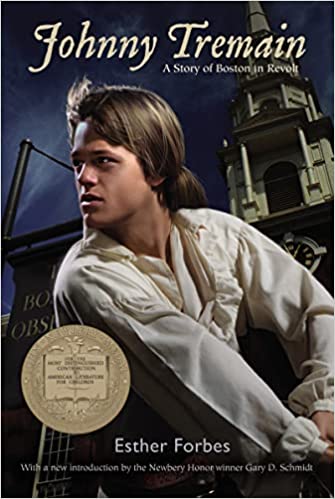
CCSS.ELA-LITERACY.RL.6.9 requires students to be able to compare similar subjects explored across different genres. Comparing Beth’s picture book to any sixth-grade book on the subject of the Revolutionary War would be a great way to show how the same subject can be handled in very different ways. The Newbery Medal winner, Johnny Tremain: A Story of Boston in Revolt, would be an excellent choice. Although Johnny Tremain is a fictional character, the author, Esther Hoskins Forbes, conducted extensive research to write the story about life during and just before the start of the Revolutionary War. Comparing a narrative non-ficiton picture book such as Cloaked In Courage to a fictional novel on the same subject would be a good way to explore this standard.
If you are interested in using narrative non-fiction picture books like Beth’s with older students, see the piece I wrote for Beth's blog on
Not Just for Little Kids: Five Reasons to Use Picture Books with Older Students. And now... I’m delighted that Beth Anderson is joining us today for a Q&A about her new book,
Cloaked in Courage.
INTERVIEW
Carolee: There are many similarities between Cloaked in Courage and Revolutionary Prudence Wright. Both books feature strong female characters, both dressing as men, to further the cause of the American rebels in the Revolutionary War. Those are ways they are similar. How would you characterize the main differences between these women?
Beth: I’m always fascinated with how people become who they are. And that’s really what Deborah Sampson’s story is about. The major difference I see between the two women is in their experiences growing up. Prudence was raised by forward-thinking parents. They sent her to school, encouraged her to participate in family “debate,” and allowed her to gain “male” skills like fishing and hunting. She was raised to see herself as a capable being. On the other hand, Deborah was “put out” at age 5 when her mother was unable to care for her children. She basically raised herself while working as an indentured servant in several households. She had to discover her capableness, sneak her education, and find her place in the world on her own. She had to dig deep for perseverance, not only to push back against the traditions that set her up for a limited life as a servant, but also the traditions that defined her future and restricted the path of women.
Carolee: I knew that parents in financial distress often hired out their children to work for other people, but I had no idea anyone would “hire” a child as young as five as was the case with Deborah. How widespread was the practice of hiring such young children? Did the parents receive money or were they just looking for room and board for children they could not afford?
Beth: I hadn’t heard of this tradition to “put out” or “bind out” children either. It offered a tremendous window into the times and her childhood as I dug into the research. Her father deserted the family, and her mother was unable to feed and clothe all her children. The restrictions placed on girls and women didn’t prepare them to make a living, so this was a heart-wrenching choice some had to make. This was basically the foster care system of the times and involved certain obligations. It was how a community cared for its members. They would place a child in the service of someone they owed a debt. As far as I know, the act of binding a child out served two purposes; it paid debts and also provided care for the child. This way, infants remaining with the mother and the children put out had a better option than starvation. Deborah was probably fortunate to first be placed in the home of an elderly aunt who cared for her and likely was the one who taught her to read and write. While this was emotionally extremely difficult, perhaps we can think of her mother’s act as generous and selfless, giving her daughter a chance in life. I could see how Deborah doing “male” chores as she grew up made her strong inside and out and prepared her for the path she was to choose later.
Carolee: Deborah survived the war but almost died of disease. What disease was it? And how often do you think the outcome of wars was affected by diseases?
Beth: Historians can’t verify which disease Deborah had, and different sources offer varied possibilities. This is why I left the disease unnamed. At the time, there were many diseases and illnesses that could be deadly: typhoid, typhus, measles, scarlet fever, smallpox, dysentery, putrid fever, malaria, yellow fever, and more. The question of what she likely had was one I put to the expert I consulted when Anne Lambelet was working on illustrations. She would need to show it. Based on the date and location, summer/fall in Philadelphia in 1783, the expert said measles. There was no vaccine for measles and many died from it. Medical staff weren’t aware of germs or viruses or what caused infection. Many practices did more harm than good. Sanitation and hygiene were lacking. And when you put troops closely together with others from different areas, contagion runs wild. Diseases affect the readiness of troops, strategies, logistics, and pose a constant danger. There’s no question that disease affects every aspect of our lives, including wars.
Carolee: You often write about little-known historical figures. How do you find out about them?
Beth: I’m always on the lookout for people and events that make us think a little differently about history. I run across these people from history in all sorts of ways - from newsfeeds of all sorts to articles or researching one thing that leads to something else. Deborah Sampson was on my radar for a while but at first, her story didn’t grab me. I had only seen very limited information on her, and nothing about her childhood. A few years later - in 2020 I think - there was an article about her being mentioned in an old diary that the Museum of the American Revolution had just acquired. It referred to her first attempt to enlist - something new to me. When I looked at that incident, it revealed more character. So I tried again. The diary turned out not to be helpful, but in digging past the surface (as with Tad Lincoln’s story), I found the person. I got a peek into motivation and experiences that made her who she was. Suddenly she inspired respect and amazement. As I researched, I found that a lot of what’s out there about her is fiction—that's been repeated as fact—and she’s sort of been appropriated for various causes. My goal was to try to tell her story as close to verifiable truth as possible, to let her be her and let that be enough. As with all things history - it’s complicated. There’s a lot of joy in digging out a piece of history that opens your eyes, but, with limited resources, these little-known figures are definitely a challenge.
Carolee: Students often read a book like yours and want to learn more about a topic. If the subject is broad, such as the Revolutionary War, it may be hard to narrow down all the possible choices. On the other hand, if they are interested in finding out about a little-known person like Deborah Sampson, there may not be many resources. Do you have any tips for young people who want to explore a topic from one of your books?
Beth: One of my goals with all my books is to spark interest in history. In my author’s notes, I share what grabbed me about a person or topic as an example for kids. I also try to offer more information about the times so there are many potential “sparks” to ignite curiosity to look further. My bibliographies list the sources I used. So many primary source documents are accessible digitally online. To see Deborah Sampson’s enlistment paper, or muster roll, or pension application is exciting! But then, take those facts and try to understand the person, their motivation, their risks, their challenges. Use critical thinking, as well as introspection, and connect as humans. That’s what makes digging into history meaningful. The back matter of this book shares some of the challenges of research, including many of the potential pitfalls. When kids start asking the WHY questions, it’s time to dig into the time and place. History becomes real and fascinating. Ask questions! And let your questions guide you.
Carolee: Thanks so much for joining us today. Are there any parting thoughts you would like to leave us about Deborah Sampson?
Beth: Thank you for sharing Cloaked in Courage and encouraging using it in classrooms! When kids understand the human side of history, they can connect. They’ll see that we, too, are impacted by our time and place and are also a part of history.
ADDITIONAL INFORMATION, LINKS, AND PREORDERS
HAPPY READING!!