Monday, February 14, 2022

Memoir Vs. Autobiography: All Our Stories Matter

WHY OUR STORIES MATTER

I've been thinking a lot about memoirs lately. I'm embarrassed to say that in the past I didn't give the genre much value, primarily because I was confusing memoir with autobiography. Autobiography tends to be about someone who is well known and focuses on the formative events that led to their success while a memoir is usually about emotional truth and people who may or may not be famous (at least not until they write a best-selling memoir)! I was under the misguided impression that a person should be a celebrity of some kind or at least have a super interesting life experience to share like being raised by circus clowns or getting stuck on a deserted island.

As a result of the pandemic, I've realized how important all of our stories are. We've had relatives, maybe not even that long ago, who survived pandemic, polio, pox, or plague, otherwise, we wouldn't be here. Wouldn't it be nice if they had left behind a written record of their experiences so we weren't so surprised and unprepared when the coronavirus hit us? Sure, we can all google information about what the Spanish Flu was like in New York City, but what about small-town Texas, or Boise, Idaho? 
Flashing forward a few decades, I think about my yet-to-be-born great-grandchildren. When tragedy strikes, whether it be pandemic, war, economic collapse, or something else, wouldn't it be nice for them to be able to find comfort and strength in family stories? Would it be grand to have something more to rely on for information, experience, and hope, besides the media and whatever they had to say about the last pandemic or whatever? Only a small number of our stories about covid will ever be published. Must our great-grandchildren rely on those stories for their history? I think it's time we start honoring our family stories, and not just the stories about tragedy and loss, but also the stories about our hopes, dreams, and love.

Last year both my father and mother-in-law died, one from a trying illness and one unexpectedly from covid. I wish they had both told me more of their stories.  I found myself with bits and pieces of their lives trying to put together a patchwork quilt with too many missing pieces. I've been going through old photographs, reflecting back on what few stories they told me of their childhood, and talking to people who knew them when they were young. 

The need for this investigation feels even more urgent because our first grandchild was born between the two deaths. Exactly six weeks after one, and ten weeks prior to the other. It's an important reminder that life goes on, but how will she understand where she came from if these stories are lost? On a similar note, how will she know my story if I don't write it down? Oral storytelling is becoming a lost art, so if we don't write down our stories, they most likely will be lost. 

As I consider how to capture the stories I want to pass along, I've been contemplating the difference between memoir and autobiography. Below is a brief look at the major differences between the two. I'm not an expert on the subject, so if you want more information, look at the sources I used:  Writersdigest.com, Masterclass.com, Bookriot.com. For tips on how to use mentor texts to encourage memoir writing in kids, see Bridging the Gap: Reading Critically and Writing Meaningfully to Get to the Core by Lesley Roessing, M. Ed. For a list of top adult memoir books, see the Writer's Digest post 19 Memoirs Aspiring Memoir Writers Should Consider Reading. 

MEMOIR VS. AUTOBIOGRAPHY

TIMELINE: An autobiography typically follows a straight chronological timeline, starting with birth and covering a person's life to date. A memoir can move back and forth in time or cover one small segment of time like a day in the life,  a summer romance, or a person's formative years. Memoir may move through time chronologically but emphasize just one aspect of a person's life such as the relationship with a parent or overcoming a fear of public speaking.

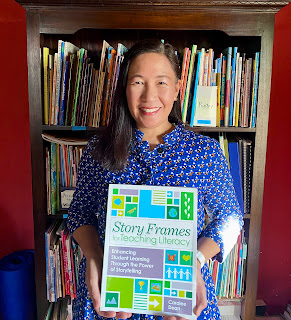
SUBJECT: As mentioned above, an autobiography is usually about someone famous or well known and focuses on facts and experiences that led to their fame while a memoir can be about anyone and tends to be about emotions or ideas. Memoir may stick close to the truth or deviate from facts since this form relies on memories, which we all know can be faulty.  Leslie Roessing, M. Ed., is a featured author in my book, Story Frames for Teaching Literacy: Enhancing Student Learning Through the Power of Storytelling (Brookes Publishing, 2021). She wrote the chapter entitled, "Memoir: Writing Our Lives," and states on p. 203, "Memoir is based on how writers remember events and what those events meant to them. Memoir differs from personal narrative in that memoir includes reflection on the importance of the persona, place, memento, or event, while personal narrative is a story of events as they happen."The emphasis is on using facts for the purpose of relating an emotional truth with more weight given to the idea than the validity of the facts. On the other hand, because of its stricter focus on facts, autobiography often includes references to world events, which should be portrayed with accuracy. Historians often use autobiographies in their research making the emphasis on truth even more important.

STYLE: An autobiography tends to use a more formal style with language that is to the point while a memoir can be more casual or even humorous and may contain figurative language. Both tend to be written in the first person (I), but are sometimes written in the third person (he, she) as if being told by someone else.

AUTOBIOGRAPHICAL

Another term that can be misleading is the word autobiographical. It is often used to refer to an autobiography, but sometimes a fictionalized story has autobiographical elements. Stories can be inspired by true events and contain very little actual truth. On the other hand, sometimes fiction based on real-life experiences contains more emotional truth than a straight retelling of the facts. 

A FINAL NOTE

Reflecting on these terms makes me wonder if there is a form of biography that is similar to memoir where we might have the license to write about the emotional truth of another person and fill in the blanks where information is missing. Then again, can we ever know someone else's truth? I suppose that is another good reason to write our own story. If we don't do it, someone else might do it for us.

Subscribe to my monthly newsletter HERE and receive a FREE fill-in-the-blank story template PDF called Travel Trouble. Each month you will get updates, activities, and tips about writing and working with students along with book news. 

Tuesday, January 25, 2022

WATERCRESS WINS BIG AT ALA

Caldecott Medal Winner
Newbery Honor Book
APALA Award Winner 

I'm so excited to share the news that Watercress, written by Andrea Wang and illustrated by Jason Chin, received three major book awards this week at the American Library Association 2022 Midwinter Meeting. Hopefully, you've heard of the Caldecott and Newbery Awards, but you may not be familiar with the APALA award from the Asian Pacific American Librarians Association. Its mission is to address the needs of Asian/Pacific American Librarians and the communities they serve.

In early summer of 2021, Andrea appeared on a panel with me, author Beth Anderson, and author/illustrator Dow Phumiruk. The topic was on Promoting Storytelling With Your Kids. The discussion and video are available on my blog with a link to the FREE PDF of the handout - Picture Books For Reminiscing. The handout includes questions for each of the picture books we discuss during the panel including Watercress. These questions may be used at home or in the classroom for any age group to stimulate discussing and writing about about personal experiences. The panel event was hosted by a local Denver bookstore, Second Star to the Right. If you are in the Denver area, check and see if they still have signed copies of Watercress available. I'm sure they are going fast!


I was not surprised that Watercress won the Caldecott given to "... the artist of the most distinguished American Picture Book for Children." Jason Chin's masterful watercolor illustrations are the perfect accompaniment to Andrea's story - an account of a personal childhood experience picking watercress from the side of the road with her Chinese immigrant parents. I was surprised and delighted, however, to learn that this quiet yet powerful picture book also won a Newbery Honor. Newbery books are typically for older students. Take for example, the recent Newbery Medal winner, The Last Cuentista, by Donna Barba Higuera. This novel for ages 10-14 is a bit more typical of the age range of books that usually win a Newbery. Read more about all of the 2022 Newbery and Caldecott Medal and Honor winners at ala.org 

What excites me most about Watercress winning a Newbery Honor, is that it demonstrates that narrative non-fiction picture books are not just for little kids. I have long been an advocate for promoting the use of picture books with older students. I hope that this award will encourage librarians and other educators to share Watercress, Unspeakable: The Tulsa Race Massacre (A Caldecott Honor Book), and other compelling and important picture book titles with older elementary school students and teens.

For specific tips on sharing these and other narrative non-fiction picture books with teens, see my article - Not Just for Little Kids: Five Reasons to Use Picture Books with Older Students over at Beth Anderson's blog. She was another author on the panel with Andrea Wang. Watch for Beth's new book, Revolutionary Prudence Wright: Leading the Minute Women in the Fight for Independence illustrated by Susan Reagan available February 1. Preorder now! Read the blog article by Sandy Brehl to learn more about the book.

The book giveaway on Beth's blog ended in November, but the tips are still invaluable. The winner of that giving away was Lillie Pardo, an intervention specialist teacher in California. Congratulations, Lillie!

To receive a free Fill-In-The-Blank Story Template sign up for my newsletter HERE.

Saturday, November 13, 2021

USING PICTURE BOOKS WITH OLDER STUDENTS

This week I'm over at Beth Anderson's blog sharing my new article - Not Just for Little Kids: Five Reasons to Use Picture Books with Older Students. In promotion of Beth's blog, I'm giving away a FREE copy of Story Frames for Teaching Literacy: Enhancing Student Learning Through the Power of Storytelling.

Just leave a comment on her blog for a chance to win a FREE book. Be sure to read the article for tips on how to use narrative fiction picture books with older students. For instance, did you know that many picture books have a similar or even higher Lexile than chapter books or novels. Consider that the highly acclaimed The Sun Also Rises by Ernest Hemingway has a Lexile of 610L while the picture book, Six Dots: A Story of Young Louis Braille, written by Jen Bryant and illustrated by Boris Kulikov has a similar Lexile of 590L. Even more interesting, Bad News for Outlaws: The Remarkable Life of Bass Reeves, Deputy U.S. Marshal written by Vaunda Micheaux Nelson and illustrated by R. Gregory Christie has a Lexile of 860L. Head over to Beth's Blog to learn more.

On a separate note, Brookes Publishing is offering a 20% discount for my book and many others at the Brookes IDA Virtual Bookstore through December 24, 2021 in honor of the recent International Dyslexia Association Conference. Just use the code IDA2021 to get 20% off your purchase including Nancy Hennessy's new book, The Reading Comprehension Blueprint: Helping Student's Make Meaning from Text.

Hennessy was generous enough to let me use one of her visuals for expository text in Story Frames. Her books is full of practical and useful tools for teachers. 

SIGN UP for my monthly newsletter to receive a FREE story writing template.


Wednesday, November 3, 2021

Children's Books Featuring Main Characters with Speech, Language, Learning, and Hearing Challenges

After spending 20 years working in the public schools as a speech-language pathologist with students with a variety of speech and language challenges, it's exciting to see so many books featuring characters with the same challenges I observed in my students. A few noteworthy titles are described below.
Unbound: The Life and Art of Judith Scott, released June of 2021, is a picture book biography for ages 4-8 exploring the life of a fiber artist with Down Syndrome and hearing impairment. Judith has over 160 sculptures featured in museums around the world. The book was written by Judith's twin sister, Joyce, along with Brie Spangler and Melissa Sweet. Born in 1943 before laws were in place to protect disabled children, Judith was not allowed to go to school and was sent to an institution instead. Joyce took Judith out of the institution as soon as she was able to live with her in California where Judith attended the Creative Growth Art Center where her innate talent blossomed. On the subject of disability rights, check out the picture book, We Want to Go to School: The Fight for Disability Rights by Maryann Cocca-Leffler and Janine Leffler who has cerebral palsy. 


See my September 20 Post about the picture book, Tad Lincoln's Restless Wriggle: Pandemonium and Patience in the President's House.  It's another new 2021 release. Read the Q&A with author Beth Anderson as she talks about the evidence that Tad Lincoln may have had a partial cleft palate in addition to speech and learning challenges. My Educator's Guide may be downloaded as a PDF

I Talk Like a River written by poet Jordan Scott and illustrated by Sydney Smith is a picture book that explores the world of a boy who is full of words, but has difficulty expressing himself because he stutters. In the author's note, Jordan Scott talks about his own struggles with stuttering. Winner of the 2021 Schneider Family Book Award. Find activities and lesson plans at Teaching Books.

A Boy and a Jaguar is the autobiographical account of author Alan Robinwitz's early struggles with stuttering. He loves visiting the cat house at the Bronx Zoo and discovers that when he talks to the animals, he does not stutter. He learns to speak for the animals and becomes a wildlife conservationist. This picture book, illustrated by Catia Chen, is for grades Pre K - 2 and is a 2015 Schneider Family Book Award Winner. The Teacher's Guide from the Classroom Bookshelf includes tips for teaching students to write memoir.

Show Me a Sign by Ann Clare LeZotte for ages 9-12 explores the little-known history of an 1805 deaf community on Martha's Vineyard. There was little distinction between the hearing and the hearing impaired because almost everyone used sign language. Though the heroine is fictional as are the events of the story, the history of the island was well-researched by the author who is deaf and the back matter includes an author's note about the island. Winner of the 2021 Schneider Family Book Award. Find Lesson Plans at Teaching Books.

Song for a Whale by Lynne Kelly, sign language interpreter, written for grades 4-8 explores the connection between Iris, a girl with a hearing impairment, and a Blue 55, a whale that cannot communicate with other whales of his species. She is the only deaf student at her school and she understands what it is like to have difficulty interacting with her peers. Winner of the 2020 Schneider Family Book Award. See the. Educator's Guide by Random House.

Just Ask!: Be Different, Be Brave, Be You written by Sonia Sotomayor, Supreme Court Justice, and illustrated by Rafael Lopez,  is a picture book for ages 4-8. Sonia writes from her own experience with having diabetes, but the additional characters, with a variety of physical and cognitive challenges, are all fictional. The book tells the story of a group of children working together to create a garden. It embraces diversity by encouraging children to "Just Ask" when they wonder about someone who is different from them. The text points out that not all children are comfortable talking about their differences, in which case children can seek answers from parents and teachers. The book includes perspectives from children with dyslexia as well as asthma, blindness, hearing impairment, autism, stuttering, Tourette's Syndrome, Down Syndrome, ADHD, and allergies. There is also a child in a wheelchair. Winner of the 2020 Schneider Family Book Award. The Lesson Guide from Read Across American includes resources for teaching kids about disability. The Nora Project offers additional guidance about the difference between showing respectful curiosity versus requiring answers of children who may feel very private about their challenges.

Wonderstruck by Brian Selznick (author of The Invention of Hugo Cabret) for grades 8-13 explores the lives of two young people with hearing impairments. Ben and Rose each set out on a journey to find lost parents that ends at the Museum of Natural history in New York City. Their stories intertwine even though they are separated by fifty years. Ben's story is told in prose while Roses's story is told in beautiful black and white illustrations. Winner of the 2012 Schneider Family Book Award. Find lessons plans from the Texas School for the Deaf Statewide Outreach Center and a Discussion Guide by Scholastic.

Rules was written by Cynthia Lord who is the parent of a child with autism. In this book for ages 11-14, Catherine develops a list of rules to help her autistic brother, David, regulate his behavior. While waiting for David at the Occupational Therapy clinic, Catherine befriends Jason, a boy in a wheelchair, who communicates via words in a communication book. The story explores feelings of love, frustration, embarrassment, acceptance, and sibling conflict. Winner of the 2007 Schneider Family Book Award. It is also a Newbery Honor Book. See the Discussion Guide from author Cynthia Lord. 

To find my list of children's books featuring main characters with DYSLEXIA, visit my October Blog Post.

Subscribe to my monthly newsletter HERE and receive a FREE fill-in-the-blank story template PDF called Travel Trouble. Each month you will get updates, activities, and tips about writing and working with students along with book news. 

Friday, October 22, 2021

Dyslexia Networks

My presentation Dyslexia Networks: Supporting Students by Fostering Collaborative Connections Between Disciplines with me, Paula Moraine, and Dr. Shreya Hessler is part of a Science of Reading Content Power Session, an extension of the 2020 Annual Conference. Is now available on IDA Streaming TV.  It is free if you paid for the 2020 IDA conference supplemental program. Otherwise, there is a fee for IDA TV. Watch for my upcoming IDA presentation, The Goldilocks Effect: Finding the "Just Right" Books for Struggling Readers. In addition, I now have a page on my blog that provides information about decodable books along with publishers and links to book information. If you are looking for titles to use with your struggling students, check out my new page HERE!

Subscribe to my monthly newsletter HERE and receive a FREE fill-in-the-blank story template PDF called Travel Trouble. Each month you will get updates, activities, and tips about writing and working with students along with book news. 

Sunday, October 17, 2021

Free Dyslexia Infographic and a Belgian Chocolate Dyslexia Fundraiser

Below is a free dyslexia infographic created by ALTA for Dyslexia Awareness Month that you may share.


The International Dyslexia Association is teaming up with Lekkco for a Chocolate for Charity fundraiser.  Go to their website for details and to order yummy Belgian chocolate.


Subscribe to my monthly newsletter HERE and receive a FREE fill-in-the-blank story template PDF called Travel Trouble. Each month you will get updates, activities, and tips about writing and working with students along with book news. 

Saturday, October 9, 2021

Children's Books Featuring Young People with Dyslexia

In celebration of Dyslexia Awareness month, this week I'm featuring children's books with main character's who have dyslexia or other language based reading challenges. Sharing these stories with students, whether fictional or real, helps them to see kids like themselves represented in literature and to know they are not alone.

Just Ask written by Sonia Sotomayor, Supreme Court Justice, and illustrated by Rafael Lopez,  is a picture book for ages 4-8. Sonia writes from her own experience with having diabetes, but the additional characters, with a variety of physical and cognitive challenges including dyslexia, are all fictional. The book tells the story of a group of children working together to create a garden. It embraces diversity by encouraging children to "Just Ask" when they wonder about someone who is different from them. The text points out that not all children are comfortable talking about their differences, in which case children can seek answers from parents and teachers. The book includes perspectives from children with a variety of challenges including asthma, blindness, hearing impairment, autism, stuttering, Tourette's Syndrome, Down Syndrome,  and ADHD. Winner of the 2020 Schneider Family Book Award. The Lesson Guide from Read Across American includes resources for teaching kids about disability awareness. The Nora Project offers additional guidance about the difference between showing respectful curiosity versus requiring answers of children who may feel very private about their challenges.

The Truth As Told by Mason Buttle written by Leslie Conner is about a boy who struggles with reading and writing. Taunted by bullies because of his dyslexia, he finds himself in continual conflict with the neighborhood boys at the same time that he is struggling with the mysterious death of his best friend. When his new friend goes missing, he must figure out what has happened. This Middle-Grade Mystery for Grades 4-8 was a National Book Award Finalist in addition to a 2019 Schneider Family Book Award Winner. See the Educator's Guide by Harper Collins.


Fish in a Tree, by Lynda Mullaly Hunt, is the recipient of the 2016 Schneider Family Book award. The story features a bright and creative six grade girl who hides her dyslexia by creating numerous distractions in class. With the help of a new teacher, she is able to embrace her dyslexia and celebrate her talents. Read the Q&A on the author's blog where she discusses her personal struggles with reading. 

Hank Zipzer: The World's Greatest Underachiever, is a series of middle-grade novels based on Henry Winkler's own experiences with dyslexia. Hank is smart, resourceful, funny, and creative, but he struggles with the many ways dyslexia can impact everyday life. The series is for grades 3-7, ages 8-12. The Here's Hank series is based on a younger version of the same boy in second grade and is written for ages 6-9. Read my post about Henry Winkler.

The Percy Jackson series by Rick Riordan features a main character with ADHD and dyslexia. Characters throughout his books face a variety of challenges. Percy Jackson, the main character of the series by the same name, has ADHD and dyslexia, but in this colorful adventure series, these differences are a sign of his extraordinary powers. He is a demigod, the son of a Poseidon. Just like the other demigods at Camp Half-Blood, he never fit into the ordinary world, especially not at school. Author Rick Riordan, a former classroom teacher, modeled Percy after his own son who has dyslexia and ADHD. In his article with The Guardian, Riordan tells how his son hated books and so each night Rick would tell him stories from Greek mythology. When he ran out of stories, his son asked him to make some up. That's when the author created the Percy Jackson character. 

Thank You, Mr. Falker is a picture book that the author/illustrator, Patricia Polacco, wrote about her early struggles with reading. See the Classroom Resource Guide for the book published by the International Literacy Association. Polacco did a video interview with Reading Rockets where she discussed her reading challenges and the Teacher Who Changed Everything. Mr. Falker was the first one to realize she had dyslexia and he even paid for her reading therapy out of his own pocket. 

See my September 20 Post about Tad Lincoln's Restless Wriggle: Pandemonium and Patience in the President's House and the Q&A with author Beth Anderson as she talks about the evidence that Tad Lincoln may have had speech and learning challenges. My Educator's Guide may be downloaded as a PDF.


My book, Take Me There, is a gritty teen story with mature subject matter for ages 14 and up that explores the correlation between incarceration and learning disability. It is a YALSA Quick Pick for Reluctant Readers. Dylan Dawson tries to turn his life around after a stint in juvie, but trouble just seems to follow him wherever he goes. On the run from the police and an LA street gang, he goes to Texas looking for his father who is in prison. When they reunite, he learns how his father's struggles with literacy limited his options which led to a life of crime, the same path that Dylan appears to be following. Even so, Dylan refuses to believe that his father is responsible for the murder for which he has been convicted and sets out to find the real killer.

On a related topic, see my previous post about Children's Authors with Dyslexia. Many of them have interviews featured on Reading Rockets. I hope you have the opportunity to share some of these great books with your struggling learners during Dyslexia Awareness Month and all through the year.

Also, in celebration of dyslexia month, subscribe to my monthly newsletter HERE and receive a FREE PDF of my decodable book, No Gift for Man. The illustrated version will be available on Amazon in November. This is the first book in the HOT ROD Series (Higher Order Thinking Through the Reading of Decodables.)