Watch the video HERE.
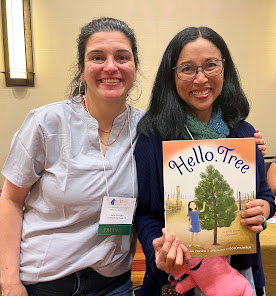
Thanks to everyone who joined me on June 1 along with Lauren Casey from Second Star to the Right Bookstore and Colorado authors Andrea Wang, Beth Anderson, and Dow Phumiruk for our author panel on Promoting Storytelling with Your Kids. It was a wonderful event. If you missed it the recording is now available above.
In the first half of the video, we talk about tips for writing personal narratives including using picture books as a conversation starter between caregivers and children. You may download a FREE PDF of my handout - Picture Books For Reminiscing. It includes questions for each of the picture books we discuss. These questions may be used at home or in the classroom to stimulate a discussion about personal experiences. Specifically for teachers, download the PDF: Writing Personal Narratives: Using Narrative Nonfiction Picture Books as Inspiration for Telling Your Story.
I've included an excerpt below of our Q&A at the end of the video which Lauren moderated. It starts about 25 minutes into the recording.
Lauren: How do you find the courage to share what you have created.
Carolee: This is a very good question, especially for kids. I remember being a kid and not wanting to stand out, not even in a good way. We don't want to be too dull, but we don't want to be too bright either. We don't want to be too tall and we don't want to be too short. One of the things that helps us to share our work is finding people we can take that risk with - sharing a little bit of ourselves and our story with people we can trust. When we are back in school it would be wonderful if we were writing more personal stories and sharing them in the classroom Validating our experiences and celebrating how different we all are helps us create connections. Today we've been talking about very different stories about people who lived before us or lived in very different places, but we each relate to each of these stories because of that connection. We need to get to the place where that connection is more important to us than our fear of rejection. Our part is that when we hear someone else's story, we let them know that is safe. We give them that acceptance. Hopefully, when it comes back around to us, someone will give us that courtesy as well.

Beth: Can I add something to that? The most significant experience I had as a teacher in writing with my students was when we were writing personal memoirs and I wrote with the kids. This applies across the board whether it's with family or in the classroom, whether it's written or whether it's oral. We all just wrote. And when I shared my memoir piece and my voice cracked at the end, and they saw me vulnerable, sharing a piece of my life and how it had an emotional impact on me, it opened up that safe place and they all shared miraculous stories of their lives. These were all immigrants and refugees. People who had very different kinds of experiences that they were not willing to share usually. I think that as adults, if we open up that space, we not only share family stories that are personal to our families that can be passed along, we create that safe space to connect at a deeper level and let kids share those emotional experiences.
Andrea: I think it is also important to remember that being brave does not mean that you aren't scared. I was always an incredibly shy kid and wouldn't show my writing to anybody except the teacher because you have to do that. Then the teacher in my third-grade class decided that she was sending all of our poems to the town newspaper, and they were all printed. That was a defining moment in my life because I thought, "Wow, my name is in the paper. I've made it." From then on it wasn't so bad because people were complimenting all of us. It was a safe place. It was a very lovely town. With
Watercress and it being such a personal story, I've been afraid since the moment that I sent it to my agent. I was essentially revealing my heart to everyone. But you really do have to embrace that vulnerability that we've been talking about. That allows other people a turn to be brave and share their own stories. That's what I really hope that
Watercress does, is to encourage everybody: parents, caregivers, and kids, to share their stories.

Dow: I love everything that everyone has said. I was going to add that you can be scared, and maybe the time isn't right to share your story, and that's okay, but when you meet that favorite teacher or that good friend, or a family member that you really connect with, that's a time to test it out. Go ahead and share things. You might be surprised. You might think that it's awful or it's embarrassing but when you share it with someone you trust and who is supportive of you, you might get a response that encourages you to keep going and keep writing. They may share their stories back with you. So give it a try. For me, I didn't feel like I wrote any stories that I wanted to share except maybe in fourth grade. Then there was a big gap until I was well into my forties before I really shared it as an adult because I didn't feel like I had anybody who really connected with me and who I was until I joined a bunch of creative people in the Society of Children's Book Writers and Illustrators. But it doesn't have to take that long. Take your chances. Find people you trust who will support you and show them what you are up to. You will be surprised. I'll bet they're going to encourage you.
Lauren: Those are such great answers. I love this so much especially because I know that we reach so many educators and so many parents who had to educate unexpectedly this school year. These are all such important messages. Something else that we get asked a lot that I would like everyone to share briefly is who inspires you? If you get stuck writing, what book do you grab or what author do you reach for to help those creative juices.
Dow: I illustrate more than I write so I look at art. I look at work from past Caldecott winners. The beautiful pieces that get me motivated are just so beautiful to look at. I imagine how I could create something similar. It never matches, but I imagine how I can attempt to portray that feeling for people who are viewing my work. That's what I try to do.

Carolee: On the heels of what Dow said, I like to read poetry. Just like a picture is a snapshot, a poem is a snapshot. Sometimes it's hard to get inspiration from an entire book. It takes so long to read it. I'm a speech-language pathologist and with my own students, I may only see them once a week. I look for something short to share with them. I'm going to pick something short like one of these picture books we've discussed today from my book, Story Frames for Teaching Literacy. A picture book is short, it's crisp, it's to the point, and yet it's so beautifully written and touches on something meaningful in a very short bit of time. Poetry is the same way. There is so much metaphor and symbolism in poetry. You can read one poem and have the main idea. I like to read something short and then just meditate on it or read something and take a walk, be out in nature where the world is full of metaphors that symbolize so much of our experience.
Andrea: Right now I'm most interested in writing more about culture and identity, so what I've been doing is I've been reading non-fiction books about the history of Asian America and Asian American Experiences so I turn to those books that discuss the making of Asian America. I will even watch documentaries. PBS has an excellent documentary about Asian Americans. I also listen to podcasts. There is one called Asian Enough that I really love. They interview Asian Americans from all walks of life. I will try to listen and take notes at the same time. It could be something completely unrelated, but it jogs something in my brain and I get an idea. Lots of different kinds of media. Not just books.
Lauren: I love that, bringing it in from all over. So you just keep a notebook with you then?
Andrea: Or my phone.
Lauren: Right. It's not 1992.
Beth: Sometimes I get stuck because I don't know enough. I'm too limited in my thinking. So I try to look at the wider picture, to get into the setting. I write a lot of history so I do a lot of research to try and understand the time and the place and the traditions and the beliefs, all of the things that are at work in that person and understanding their life. If it's an idea that is theme-related, I read other articles about that topic and it exposes me to different viewpoints and makes me jog my thinking a little bit. So that's usually what I do. Or take a walk.
Lauren: I love the walks, yes! To end, I know that you all gave really great advice when you were speaking about different tips that you have for parents, but I wonder if we could speak to educators specifically. We love our educators. We work with so many schools and we love them all. What advice do you have for educators, especially after this hard year? Virtual school was rough. People may not be feeling like they want to share their stories. I think a lot of people are shut down. Do you have any advice for the classrooms or for home learners? How can they open that back up? How can we break out of the pandemic blues?

Andrea: I have a writing exercise that I give out when I do school visits and educators can use this too. Taking a cue from Watercress, write about a memory, but choose one where your feelings change from before the activity to afterward and that's really where your story lies. For example, in Watercress, the girl in the story feels very embarrassed and confused about why her parents are making her pick watercress. By the end, when her mother shares her own story from her past about her relationship to watercress growing up during the Great Famine in China, the girl then gains a new understanding and awareness and her feelings have really changed by the end. She's much more connected to and proud of her heritage. Remind kids that they can be proud of who they are and where they are from.

Beth: I think that the best writing comes from writing you really care about that really fires you up whether it's anger or passion or love. If it is hooked in emotionally it goes much deeper and it's not just for the teacher. It's more for you. Teachers know that the best way to get kids to learn is to connect with them and to reach them on an emotional level. If you can make assignments touch on the emotional level like - Why does this matter? Why do you care about this? Whether it's science or social studies or whatever it is. One of the things I've talked with kids about during my visits with Lizzie Demands a Seat is about how your time and place affect who you are. Interpreting a fact, like she's a teacher, became very different. When you look at the times and the place, she actually was an activist as a teacher. It totally changes motivation and everything about the story. I say that if you don't think that your time and place affect you, think about your life now with the pandemic. You will never think the same. You will always see things differently. This will forever affect your view of the world and this will be something you tell your kids about. That's how you become you. Get it on the page or in your speech or in whatever you're doing. Let that emotion connect you.
Carolee: I love the books that we've talked about today. These are what I use when I work with students and I tend to work with students who have pretty significant learning challenges. As a speech-language pathologist, I specialize in working with students with dyslexia, so when I read a book it's not just to find the main idea or answer detail questions, I tell my students, "I have something so special to share with you today. It's a book about a woman who saves the Apollo 13 mission." I only share books I love and it just to happens that they are usually narrative non-fiction picture books that are absolutely full of vocabulary, main idea, with all of those things we want kids to learn without it being drill and kill and now let's have a test over the book. You can't help but learn from the story because it's so exciting. Sometimes we'll just analyze an illustration. We will talk about who is the subject of the picture. What are they doing? Where is it happening? When? Why? That is basically the construct of a complex sentence. We use that conversation to build how complex sentences are made from either looking at the pictures or reading the book. I would challenge teachers to find books you love that you cannot wait to share with your students. That enthusiasm is contagious. If our students learn nothing more from us than a love for stories, then we will have done a great thing because the stories do the work. Kids learn so many life lessons from those stories, and if we can encourage that love of stories by loving stories ourselves, and sharing that love and sharing that enthusiasm, then we will have done a great thing.
(Side Note: Obviously, there is much more work that we need to do besides simply fostering a love of books, especially for kids who struggle with learning to read, but sharing our enthusiasm will help remind our students of why all of that hard work is important.)
Lauren: I'm so glad we are recording this my friends. This is amazing advice.
Dow: I love that you can encourage yourself to bring your own enthusiasm for books to the classroom. I think that is great advice. Just in case you hadn't heard anybody else on this soapbox yet - let children choose their own books to read. Let them pick what they are interested in be it a picture book or a graphic novel or YA books that are banned in a few states. These are safe ways for children to learn as they make that discovery on their own with a book of their choice. It's going to stick with them and they're going to become lifelong readers and learn about the world that way. Picture books are my favorite and I think that adults and children alike need picture books. I think the world would be a kinder, gentler place if we all embraced picture books. Let children pick as well what they prefer.
Lauren: I love that, and I think I know a store where these children can go to pick their own books. We might just have a place on South Pearl Street. Thank you all so much for being here today and for sharing such amazing advice. Carolee, thanks for orchestrating this and putting us all together and getting us out in front of our audience. Thank you!
Carolee: I could not have done it without the great material and the great authors that are here with us today sharing their amazing talent.
Lauren: Once again friends, my name is Lauren from Second Star to the Right. Thank you so much for joining us here today. Happy reading and we'll see you next time. You can find these books on our website:
Check out books from our Story Frames Panel at Second Star to the Right Books:
Story Frames for Teaching Literacy: Enhancing Student Learning Through the Power of Storytelling by Carolee Dean
Watercress by Andrea Wang
Magic Ramen: The Story of Momofuko Ando by Andrea Wang
An Inconvenient Alphabet: Ben Franklin and Noah Websters Spelling Revolution by Beth Anderson
Lizzie Demands a Seat: Elizabeth Jennings Fights for Streetcar Rights by Beth Anderson
Counting on Katherine: How Katherine Johnson Saved Apollo 13 written by Helaine Becker and illustrated by Dow Phumiruk
Titan and the Wild Boars: The True Cave Rescue of the Thai Soccer Team written by Susan Hood and Pathana Sornhiran and illustrated by Dow Phumiruk.
To receive a free Fill-In-The-Blank Story Template sign up for my newsletter HERE.
To watch the video on Tips for Leisure Reading by New Mexico authors, go HERE.